

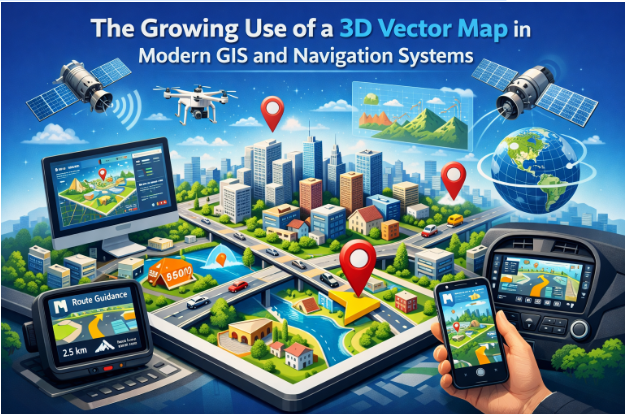
Navigations and geographic information systems (GIS) are changing at a rapid rate to suit the needs of more intelligent cities, autonomous transport, and data-driven decision-making. The conventional 2D methods of mapping could not capture the complexity of the real-world environment anymore. The 3D version of the vector map is therefore becoming very popular in the new GIS and navigation systems due to its high level of accuracy, scalability, and usability.
With mathematical precision in combining three-dimensional spatial data, 3D vector maps are transforming the way geographic information is analyzed and applied.
Why GIS and Navigation Systems Need Advanced Mapping
Examples of the many applications that can be done on modern GIS platforms include: planning of cities and towns, transport management, environmental studies, and emergency responses. Navigation systems, on the other hand, require real-time precision and clarity in order to direct a user safely and efficiently.
One way of satisfying these requirements is to produce a 3D representation of a vector map of geographic features, where each feature is represented by fine coordinates, lines, and surfaces, instead of fixed pixels. The structure enables seamless scaling of maps without any loss of data, which makes them effective in the analysis of a large area and the analysis of a specific route in great detail.
Better Recreation of Three-D Environments
The capability to reflect elevation or depth and vertical structures, which is one of the most significant strengths of a 3D vector map. Knowledge of vertical relationships is needed in urban settings characterized by bridges, tunnels, high-rise buildings, and multi-level roads.
The GIS and navigation systems are assisted with 3D vector maps:
- Imagery deviation and slopes.
- Urban density and heights of model buildings.
- Represent the underground infrastructure and the overground infrastructure.
This three-dimensionality enhances situational awareness and navigation greatly.
Increased Precision of Real-Time Navigation
The proper and current data is required to run the navigation of a system. A 3D vector map also allows the accurate positioning and routing of the map, as it has the same geometry at all zoom levels and platforms.
This accuracy enhances:
- Navigation on high traffic streets.
- Complex road network lane-level guidance.
- Pedestrian, bicycle, and vehicular routing.
These maps also become highly visible when created by the finest 3D rendering firm, hence the end users have an easier time navigating them.
Large and Complex Data Scalability
GIS systems can frequently process huge amounts of spatial data. The raster-based maps may get cumbersome and ineffective as datasets increase. Contrary to this, a 3D vector map scales effectively because it keeps geographic features as reusable mathematical entities.
GIS platforms can:
- Load and process data faster
- Represent big geographical locations smoothly.
- Scales to increasing datasets with no performance degradation.
Scalability is a crucial need as GIS applications are spread.
Seamless Integration with Modern GIS Platforms
The current GIS solutions combine data collected by satellites, sensors, drones, and IoT devices. These ecosystems are natural homes of a 3D vector map, which is necessary to interpret data and provide up-to-date information.
GIS experts are able to superimpose other data like traffic flow, population density, and environmental measurements over 3D vector maps to come up with more robust and practical insights.
Embracing Advanced Navigation Technologies
The emergence of autonomous cars, intelligent transportation, and AR direction has raised demand for advanced mapping solutions. The spatial accuracy needed to make these technologies operate safely and efficiently is found in a 3D vector map.
Indicatively, the autonomous systems rely on the 3D profiles of the road geometry, obstacles, and the environment. Reliable mapping of their environment is possible through accurate mapping in a vector format, which allows these systems to react to their environment more reliably.
Enhanced Visualization for Decision-Makers
GIS does not just belong to the analysis of data but also to communication. Visualizations are highly valued by decision-makers to comprehend the trends in geography and evaluate the results of projects. An interactive vector map is a 3D representation of complicated spatial material converted into vivid and comprehensible images.
The cooperation with the most effective 3D rendering firm guarantees that these maps offer a reasonable compromise between technical precision and visual elegance, thus being appropriate in terms of presentations, open consultations, and strategic planning.
Future-Proofing GIS and Navigation Systems
With the improvement of the technology environment, mapping systems have to keep up with the new sources of data, platforms, or user demands. The 3D vector map offers the flexibility to keep up with the emerging technologies and which does not affect the accuracy.
Combined with its scalability to digital twins and AI-based analytics, and real-time data feeds, it is a more future-proofed GIS and navigation systems solution.
Conclusion
The current trend of utilizing the 3D vector map in recent GIS and navigation systems represents the increasing demand for scaled, precise, and smart mapping systems. The 3D vector maps are defining the future of geographic technology by providing accurate spatial representation, scalability, and intricate visualization features.
Organizations can also enjoy the maximum capabilities of 3D vector mapping with the assistance of the best 3D rendering company in the process of creating smarter and more dependable GIS and navigation systems.
